History 1939–2021
Established in 1939 in Tbilisi, JSC Elmavalmshenebeli developed from a specialized locomotive repair workshop into the premier heavy mainline electric locomotive enterprise in the region.

Due to the planned expansion of the Tbilisi Steam Locomotive Repair Plant, a decision was made to relocate the entire manufacturing complex to the city's outskirts alongside a comprehensive modernization.
The electric locomotive repair workshop carried out the modernization of motor-car rolling stock operating on 3000 V DC.
The plant officially entered operation as a specialized locomotive repair facility.
Following the adoption of the general railway electrification plan and rising demand for mainline locomotives, a government decision directed the Tbilisi locomotive repair plant to initiate serial construction of mainline electric locomotives.
The enterprise was officially renamed the "Electric Locomotive Manufacturing Factory" (TEVZ). With support from engineers and technicians of the Novocherkassk Electric Locomotive Plant, assembly operations were organized and a major reconstruction began. On December 30, the factory rolled out its first mainline locomotive, N8-201 (later redesignated VL8-201), marking the inception of electric locomotive manufacturing in Georgia.
To accelerate technological progress, the factory established a proprietary Special Design Bureau (SKB) dedicated to engineering new mainline locomotives. The plant localized the manufacturing of essential assemblies: traction motors, auxiliary machinery, starting-regulating apparatus, pantographs, and protection gear (totaling roughly 1,000 unit assemblies and components). Within its first decade, TEVZ produced 250,000 components, covering up to 80% of demand.
The SKB engineered the T8, subsequently designated the VL10 series 8-axle mainline DC freight electric locomotive.
Between 1963 and 1965, the SKB designed—and between 1966 and 1967 assembled—two prototype VL40 passenger AC electric locomotives (25 kV, 50 Hz) with a design speed of 160 km/h, Class III monomotor group drives, and 1,600 kW TL-1 DC traction motors.
The SKB designed and built the VL-8V—the world's first dual-voltage (3 kV / 6 kV DC) electric locomotive featuring pulse-width modulation speed control.
Serial production of the EK-13 series specialized industrial coke-quenching electric locomotives began, launching the plant's international export footprint. Early units were exported to Turkey, India, Poland, Bulgaria, Romania, and Czechoslovakia.
The plant developed and launched serial production of the ETP-186 electric thermal warehouse loaders. These machines were deployed across warehouse operations in Hungary, Yugoslavia, Turkey, Yemen, Iraq, and India, and were exhibited at international industrial fairs in Budapest, Bucharest, Brno, and Leipzig.
Leveraging advances in semiconductor engineering, the SKB engineered the EK-14 thyristor-controlled industrial coke-quenching locomotive, achieving automated traction control and precise speed stabilization. The EK-14 entered widespread service across heavy metallurgical plants internationally.
To meet growing freight volumes on electrified lines, the factory developed the VL11 series 8-axle twin-section mainline freight locomotive. The design allowed multi-unit operation in three- and four-section configurations, significantly expanding haulage capacity on heavy-gradient corridors while cutting operational overhead.
Serial manufacturing of the heavy-duty VL10U freight locomotive began, featuring an increased axle load of 25 metric tons.
The factory began producing the modernized ETP-188M industrial loader for export. To satisfy escalating demand for DC rolling stock, a master reconstruction was implemented, adding advanced manufacturing bays and modern tooling that doubled annual output capacity.
Historic all-time production record: the enterprise produced 138 mainline locomotives in a single calendar year.
The SKB completed development of the VL15 series—a 12-axle twin-section DC mainline freight locomotive delivering 9,000 kW of continuous traction power.
Height of late Soviet output: 130 heavy mainline locomotives delivered.
Design and assembly of the E13 mainline freight locomotive; two units were completed and delivered in 1992.
The enterprise underwent corporate restructuring and was reorganized into JSC Elmavalmshenebeli. During this year, 18 locomotives were produced before Russian Railways ceased procuring DC electric locomotives, causing post-Soviet supply-chain disruptions.
Amid broader macroeconomic crises and severed supplier networks across the former bloc, locomotive assembly was temporarily halted.
Full production resumed. The plant localized its assembly cycles by constructing an in-house locomotive paint spray chamber and body fabrication workshop, while sourcing specialized electronics and static converters from suppliers in the Czech Republic. Georgian, Ukrainian, and Azerbaijani national railways became the primary ongoing operators (averaging 5–10 locomotives annually).
Passenger Rolling Stock: 4E1 & 4E10 Series
- 2000:Under contract for Georgian Railway, the plant engineered and built two brand-new 4-axle DC passenger locomotives, designated 4E1 (units #001 and #002). Concurrently, a conversion program was developed using detached sections of 8-axle units to create the 4E10 4-axle passenger/utility locomotive (15 units produced through 2008).
- Preliminary R&D commenced on an 8-axle dual-system prototype under the 8E1 project.
Industrial Metallurgical Rolling Stock
- 2005:The SKB developed the next-generation EK-15 coke-quenching locomotive (two units built and deployed at the coke batteries of Severstal).
- 2005–2006:Upgraded EK-14U coke-quenching locomotives were manufactured and supplied to metallurgical plants in Russia, Ukraine, and Kazakhstan (393 units constructed across the extended EK-14 lineage).
- The factory celebrated the 50th anniversary of rolling out its first electric locomotive.
- Serial production of the VL11M/5 series began, featuring reduced structural steel mass, an enlarged operator cab, MORS SMITT (Germany) automated switchgear and relays, and ergonomic dual consoles (13 units delivered to Ukraine and Azerbaijan in 2007–2008).
- Under contract for Delton LLC, the plant engineered and produced the modernized 4-axle 4E10I (4E10i) passenger locomotive.
- On order from Ukrainian Railways, production launched for the modernized VL11M/6 series (incorporating microprocessor traction control, modular cabins, and static auxiliary converters); the first 2 units were delivered.
The Ukrainian Railways Contract
- 2011:The State Administration of Railway Transport of Ukraine (Ukrzaliznytsia) signed a $483.13 million contract for 110 VL11M/6 freight locomotives.
- A total of 28 VL11M/6 locomotives were built and delivered to Ukraine: 2 units in 2008, 3 in 2010, 4 in 2011, 3 in 2012, 11 in 2013, and 5 in 2014 (including units #503, #504, and #505).
- December 2014:JSC Elmavalmshenebeli won two major procurement tenders with Georgian Railway for rolling-stock overhauls and components.
- 2015:4 units of the VL11M/6 series were purchased and commissioned by Azerbaijan Railways (ADY).
- March 2015:Advanced metallurgical laboratories were upgraded with high-precision DFS-500 (ferrous and non-ferrous analysis) and MFS-11 optical spectrometers.
The enterprise manufactured and exported the MPE2U-001—an ultra-heavy DC quarry traction complex featuring motorized dumpcars—to the Almalyk Mining and Metallurgical Complex (AGMK) in Uzbekistan, where it entered operational service at the Kalmakyr open-cast deposit.
JSC Elmavalmshenebeli built and delivered the second unit of this heavy industrial series, the MPE2U-002, to AGMK, expanding the plant's electrified mining haulage fleet.
Sovereign Engineering for Critical Regional Rail Logistics
The mission of JSC Elmavalmshenebeli is to ensure continuous rail freight mobility across the regional transport corridor by delivering certified, heavy-duty DC electric locomotives and comprehensive fleet capital repairs.
We uphold rigorous metallurgical and mechanical engineering standards established over eighty-five years of industrial practice, combining proprietary patents with modern electronic microprocessor control systems.
Through relentless quality governance and continuous workforce technical training, we maintain Georgia's sovereign capacity to build, overhaul, and modernize heavy rolling stock.
QUALITY MANAGEMENT SYSTEM
ISO 9001:2008 Quality Certification
Scope of Certified Engineering Works
Manufacture, capital overhaul, modernization, and life extension of mainline DC electric freight locomotives, industrial coke-quenching locomotives, traction motors, wheelsets, and auxiliary electrical apparatus.
Official factory documentation records: Four primary certificate scans verifying compliance with ISO 9001:2008 standards (validity dates running 2010 to 2013) for heavy railway rolling stock production and component overhaul.

INDUSTRIAL INFRASTRUCTURE
Territory Layout & Facility Scale

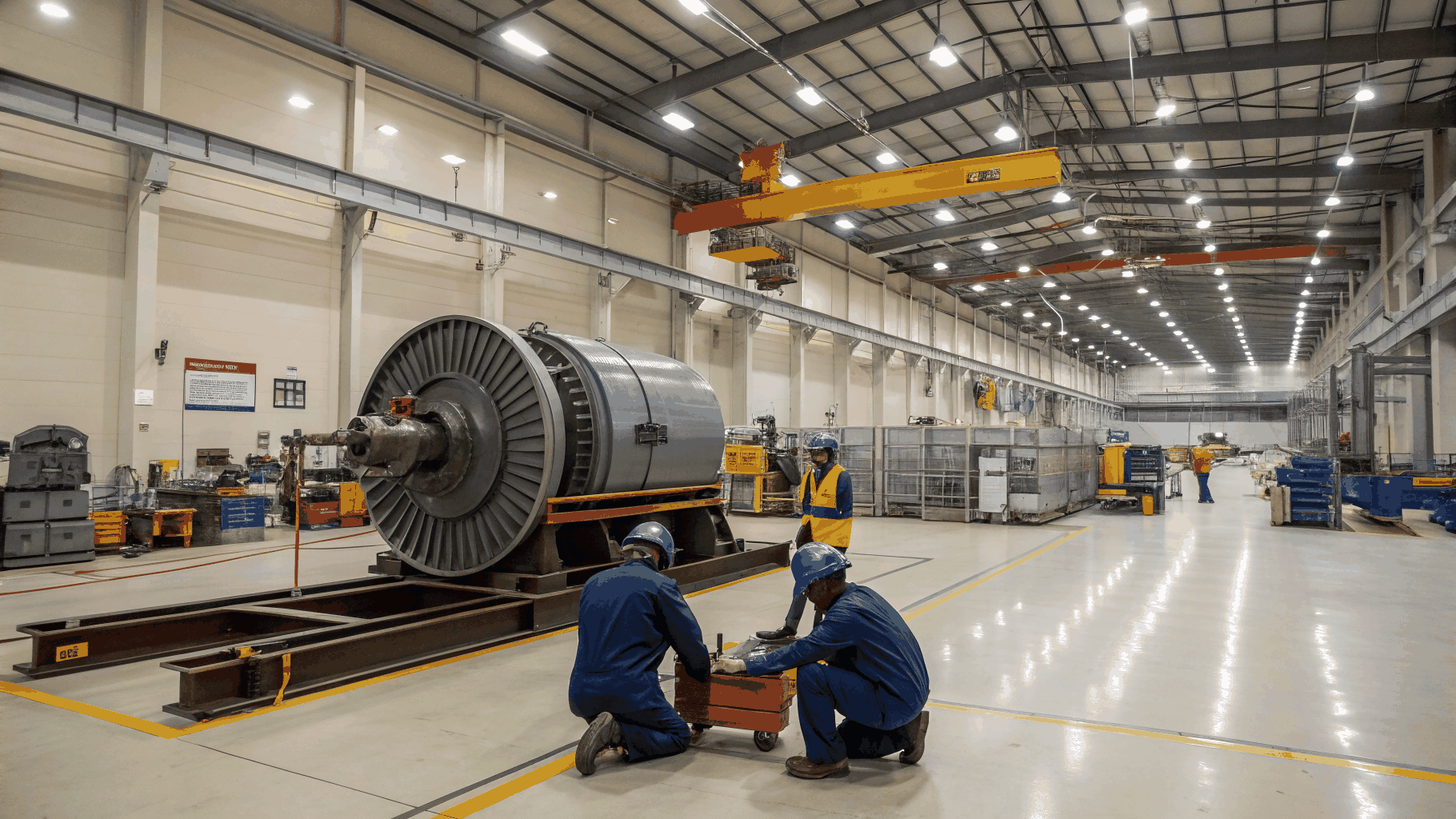
Total enclosed territory of the Tbilisi locomotive manufacturing complex, comprising heavy mechanical assembly halls, foundry bays, testing tracks, engineering bureaus, and direct mainline rail connections.
Direct standard-gauge spur rail connection to the Georgian Railway mainline corridor.
Overhead heavy gantry crane infrastructure supporting dual-section 180-tonne locomotive transfers.